
 Frank
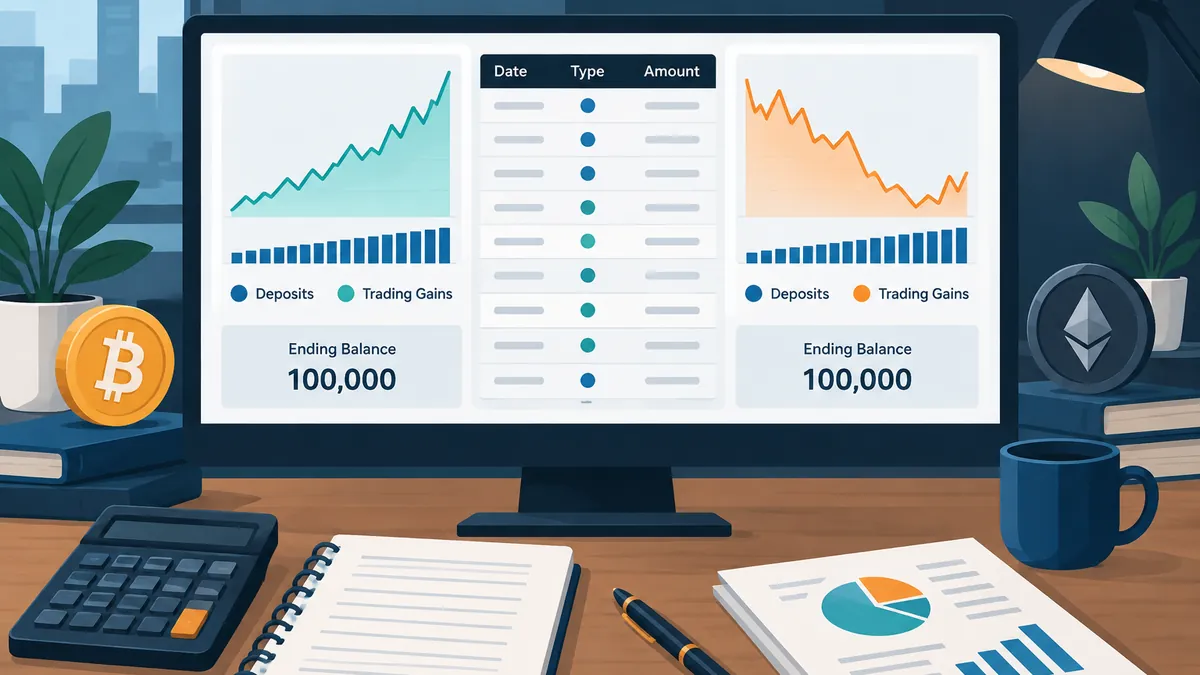
A crypto account held €10,000 at the start of the month and €15,000 at the end. That looks like a 50% return. But if you deposited another €6,000 during the month, the investment result was negative: some capital was lost. An attractive balance chart does not reveal this, and an automatically generated report may simply repeat an incorrect calculation with confidence.
To evaluate trading performance, separate portfolio value, external cash flows and investment results. Then choose the measure that answers your question: how well the strategy performed, or what return your own investments earned after accounting for the timing of deposits.
Why a change in balance is not an investment return
Trading is not the only thing that changes a balance. Deposits, withdrawals, changes in the value of open positions, fees, staking rewards and other transactions also affect it. The first step is therefore to define the reporting boundary: one exchange account, several platforms, or an entire portfolio that includes personal wallets.
For a simple spot portfolio, check the absolute result for the period using: ending value − starting value − external deposits + external withdrawals. Express every amount in the same currency. This gives a monetary result, not a percentage return: the formula does not account for how long each deposit was invested.
Financial AI assistants can help explain and present an analysis. For example, https://www.numevia.io/ advertises transaction, income and expense analysis, along with report generation. However, support for crypto exchange exports and calculation of the metrics discussed here are not confirmed. The service’s terms describe the current build as a front-end demo and state that outputs are not financial advice. Establish the accounting rules before assigning work to an assistant.
Choose the valuation currency in advance, too. Returns measured in BTC can differ from returns measured in euros, and a stablecoin should not automatically be treated as equal to one unit of fiat currency. Every portfolio snapshot needs a consistent valuation time and an agreed source of prices.
Separating deposits and withdrawals from transfers between your accounts
If the report covers only an exchange, an incoming transfer from a personal wallet is an external deposit into that account. If the wallet belongs to the portfolio being analysed, the same transfer is internal: it changes where the asset is held without adding capital. Classification depends on the portfolio boundary, not the transaction label in an export.
For an internal transfer, match the outgoing and incoming entries by asset, time, amount and, where available, transaction identifier. Identify fees separately: sending 1 ETH and receiving 0.999 ETH does not mean a trading loss of 1 ETH followed by a new deposit of 0.999 ETH. Check the difference against network and exchange charges.
A purchase and sale history alone is insufficient. The official guide How to export your account history on Kraken distinguishes Trades—executed trades—from Ledgers, which include account movements such as deposits, withdrawals and fees, and Balances, which show holdings at a particular date. Select the relevant periods and fields for reconciliation; check the contents of exports from other platforms separately.
Maintain a unified ledger containing the time and time zone, platform, event type, asset, quantity, fee, reporting-currency value and source identifier. Buying ETH with USDT inside the portfolio is not a withdrawal of USDT followed by an external contribution of ETH. It is an exchange of assets, not a movement of the owner’s capital.
Rewards and expenses need explicit rules. For example, staking income earned within the portfolio generally belongs in the investment result rather than being treated as a new owner contribution. Margin trading also requires accounting for liabilities, funding charges and interest: asset value without the deduction of debt overstates equity.
Example: identical balance growth, opposite trading results
Consider two hypothetical spot accounts with no borrowing. The reporting currency is euros, the ending valuation includes open positions, and all trading fees have already been accounted for. Both accounts start at €10,000 and finish at €15,000. A deposit takes place exactly halfway through the period.
- Account A: by the midpoint, its value has risen to €11,000. The owner deposits €4,000, bringing the value to €15,000, where it remains until the period ends.
- Account B: by the midpoint, its value has fallen to €9,000. The owner deposits €6,000, restoring the value to €15,000; there are no subsequent changes.
Account A’s result is €15,000 − €10,000 − €4,000 = +€1,000. Account B’s result is €15,000 − €10,000 − €6,000 = −€1,000. The same 50% balance growth conceals opposite investment results.
Subperiod returns also differ. Account A earns 11,000 / 10,000 − 1 = 10% before the deposit and 0% afterwards. Account B’s corresponding returns are −10% and 0%. A deposit should not itself create a jump in investment performance.
These figures show the total result, including changes in the value of unsold assets. This is not the same as realised profit, nor does it automatically become the taxable amount. Tax accounting requires the rules of the relevant jurisdiction and the assets’ acquisition history.
Time-weighted or money-weighted return: which measure to use?
TWR, or time-weighted return, helps assess portfolio performance without distortion from external deposits and withdrawals. Split the period at external cash flows, calculate each subperiod’s return, then multiply the growth factors: TWR = (1 + r₁) × (1 + r₂) × … − 1. In this example, that produces +10% for Account A and −10% for Account B.
An exact calculation requires portfolio valuations immediately before the flows and correct treatment of the flows themselves. Opening and closing balances alone are insufficient. If only daily snapshots are available, specify how intraday deposits are handled and disclose the resulting limitations instead of presenting an approximation as an exact TWR.
MWR, or money-weighted return, accounts for the amounts and dates of the owner’s investments. It is often calculated as an internal rate of return, or IRR; an XIRR-type calculation accommodates irregular dates. It measures the return on the capital actually invested, so the timing of deposits and withdrawals matters.
For Account A, with its deposit exactly halfway through the period, the equation is: 10,000 × (1 + r) + 4,000 × (1 + r)1/2 = 15,000. Solving it gives approximately 8.36% for the full period. This does not contradict the 10% TWR: the additional money was in the account only during the second half, when no further return was earned.
The differences between these measures, and the need to account for fees and expenses, are discussed in A Primer for Investment Trustees — Session 8: Performance Evaluation, particularly on printed pages 93–94. TWR is generally useful for comparing strategies; MWR reflects the investor’s personal experience. A report can show both, provided it clearly identifies the period and whether a rate is annualised: XIRR typically returns an annual rate.
Checking an AI report: source data, formulas and reconciliations
AI should explain calculations that can already be checked, not replace the underlying ledger with confident prose. Provide anonymised data and explicit rules: portfolio boundaries, valuation currency, time zone, transfer classifications and fee treatment. Never upload seed phrases, private keys or API keys that permit trading or withdrawals.
A provider’s stated transparency and the reproducibility of a particular report are different things. The page titled О компании NUMEVIA describes access to information about AI usage, resource consumption and analytical results. That is a description of the company’s approach, not confirmation of an audit trail or disclosure of return-calculation formulas.
Start practical checks with the balance of each asset: opening quantity plus incoming transfers and purchases, minus outgoing transfers, sales and fees charged in that asset, should equal the closing quantity. Then reconcile the reporting-currency valuation separately. A matching total is not enough: errors in two assets can accidentally cancel each other out.
Ask the assistant to list excluded rows, unmatched transfers, missing prices and possible duplicates, rather than merely writing a conclusion. A trade in Trades and its corresponding entry in Ledgers must not be counted as two separate trades. Likewise, a fee must not reduce the result twice if it is already reflected in the net balance change.
Recalculate percentages in a spreadsheet or a verifiable script. Save formulas, rounding rules and intermediate valuations. If IRR fails to converge or produces an ambiguous result with a complex sequence of cash flows, disclose that limitation rather than replacing it with profit divided by total deposits.
What to keep when closing the monthly trading journal
Make the monthly close reproducible: use the same cutoff time, reporting currency and classification rules. Keep source exports separate from processed files so corrections can be traced and repeated.
- Trade, ledger and balance exports from every included platform and wallet.
- A list of dated external cash flows and matched pairs of internal transfers.
- Prices and valuation times, including valuations around external flows for TWR.
- Calculations of the absolute result, TWR and, where needed, MWR, with the period specified.
- A record of discrepancies, assumptions and corrections since the previous version.
If some data is missing, issue a provisional report with a qualification rather than a precise-looking percentage. A reliable summary answers three separate questions: how much capital you added, how much the portfolio gained or lost, and how cash-flow timing affected your personal return. That is what turns a balance history into a tool for monitoring trading performance.